

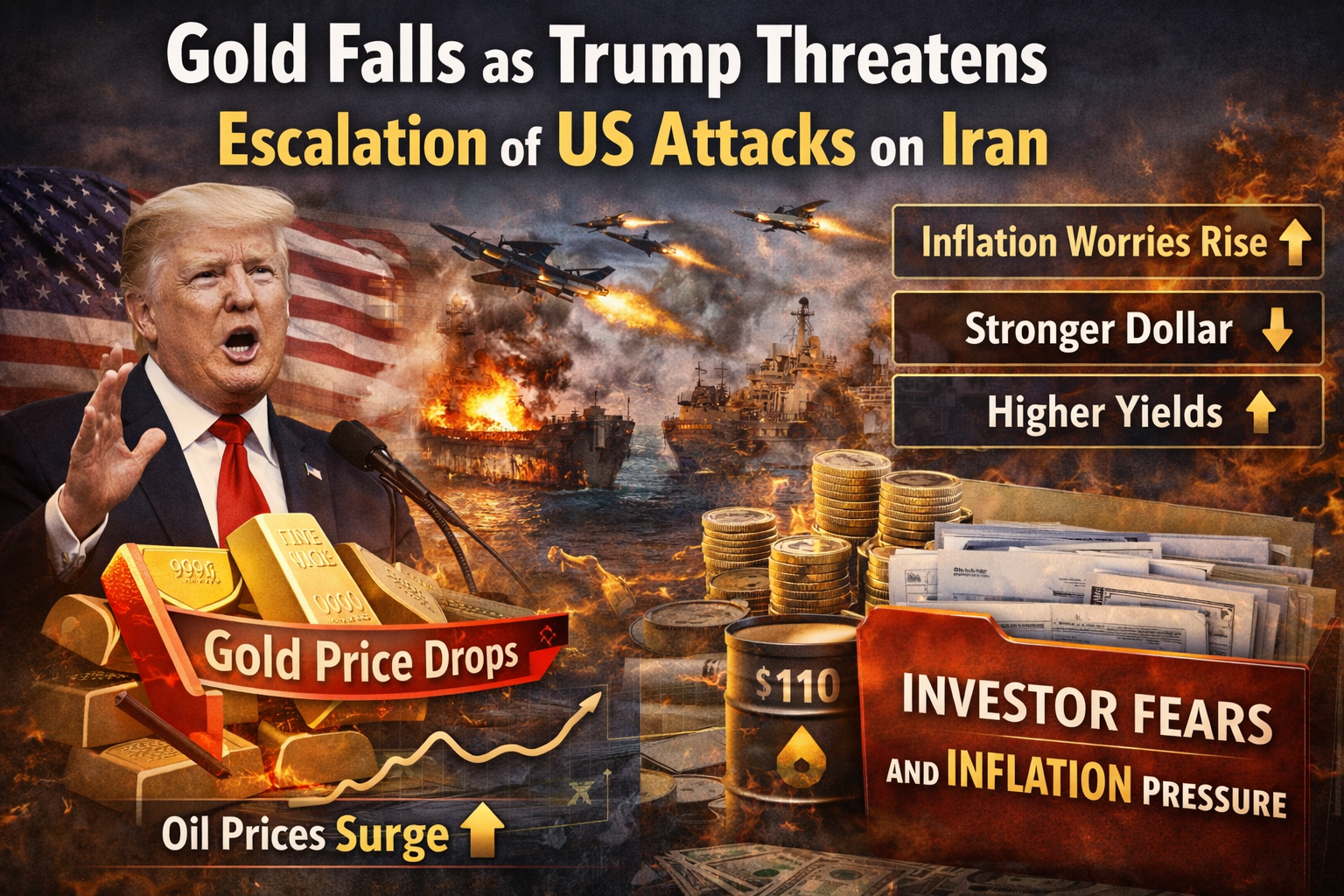
Gold prices declined sharply in global markets after U.S. President Donald Trump signaled a potential escalation in military action against Iran, raising concerns about inflation and shifting investor sentiment.
According to market data, bullion dropped as much as 1.4%, slipping below $4,610 per ounce, extending losses from the previous session.
Escalating War Tensions Impact Markets
The decline in gold prices comes amid intensifying tensions in the Middle East. Trump warned of severe military action, including possible attacks on Iran’s infrastructure, if Tehran fails to comply with U.S. demands—particularly regarding the reopening of the strategically vital Strait of Hormuz.
Iran has rejected these warnings and continues retaliatory actions, including strikes targeting energy infrastructure, further deepening the conflict.
Why Gold Is Falling Despite Crisis
Traditionally, gold is considered a safe-haven asset during geopolitical crises. However, the current situation is producing the opposite effect.
The escalation in conflict has pushed oil prices higher, increasing inflation expectations globally. As inflation rises, central banks are less likely to cut interest rates—making gold, which does not yield interest, less attractive to investors.
At the same time, a stronger U.S. dollar and rising bond yields are further reducing gold’s appeal.
Oil Surge and Inflation Fears
Oil markets have reacted strongly to the crisis, with prices surging above $110 per barrel due to fears of supply disruptions.
The Strait of Hormuz, through which nearly 20% of global oil supply passes, remains a key flashpoint. Any prolonged disruption in this region could further drive up energy prices and global inflation.
Broader Market Reaction
The geopolitical uncertainty has triggered volatility across financial markets:
- Oil prices: Rising sharply due to supply fears
- Gold: Falling despite safe-haven demand
- Stocks: Mixed performance amid uncertainty
- Dollar: Strengthening on risk-off sentiment
Recent data also showed gold dropping alongside other precious metals, reflecting a broader shift in investor positioning.
Outlook
Analysts warn that gold prices may remain under pressure if tensions continue to escalate and inflation expectations rise further. However, any signs of de-escalation or economic slowdown could quickly restore gold’s appeal as a safe-haven asset.
For now, markets appear to be driven more by interest rate expectations and energy prices than by traditional geopolitical risk factors.